North America and Europe combined represent about 33% of the Xylene Market volume, with diverging outlooks shaped by energy transition policies
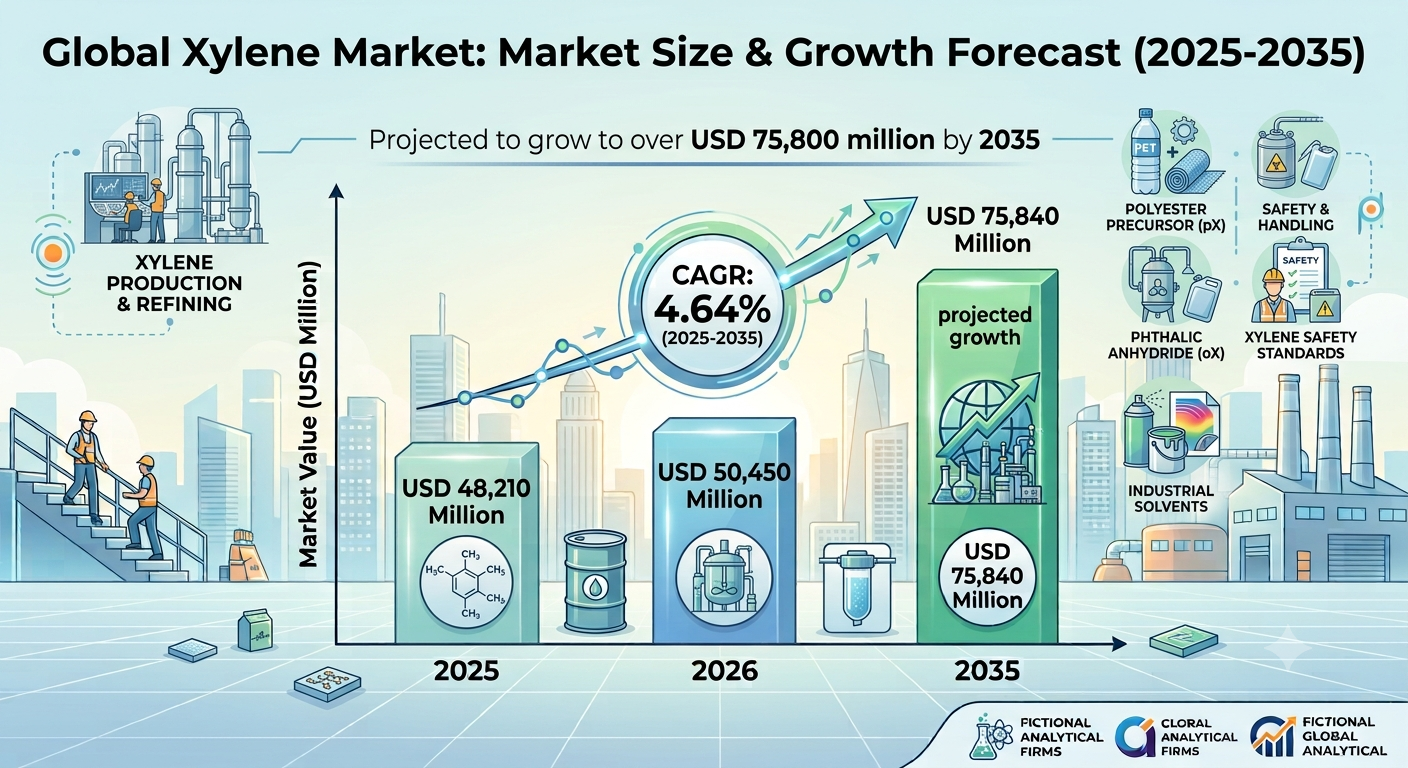
OR, UNITED STATES, August 27, 2026 /EINPresswire.com/ — According to Market Research Future, the global Xylene Market was valued at approximately USD 48,210 Million in 2025 and is projected to reach USD 75,840 Million by 2035,, expanding at a 4.64% CAGR during 2026–2035.
The Xylene Market is experiencing steady expansion as demand increases for para-xylene, solvents, polyester, PET packaging, coatings, specialty chemicals, and industrial intermediates. Xylene is an aromatic hydrocarbon consisting of three principal isomers—para-xylene, ortho-xylene, and meta-xylene—and is an important feedstock across the global petrochemical value chain.
PET and Polyester Demand Strengthen the Xylene Market
The growing global consumption of PET packaging and polyester fiber is one of the most significant factors supporting the Xylene Market. Para-xylene is converted into purified terephthalic acid, which is subsequently used in PET resin and polyester production.
The continued expansion of bottled beverages, food packaging, consumer goods, textiles, and synthetic fibers is therefore directly connected to demand for para-xylene. According to MRFR, para-xylene accounted for approximately 91% of the Xylene Market in 2025, reflecting its dominant role in PET resin and polyester applications.
The expansion of PET manufacturing capacity, particularly across China and Southeast Asia, is creating a stable downstream demand base. Brand commitments toward recycled and lower-carbon packaging are also influencing the feedstock landscape without eliminating the underlying demand for aromatic intermediates.
Para-Xylene Maintains Market Dominance
By type, the Xylene Market is segmented into Para-Xylene, Ortho-Xylene, and Meta-Xylene. Para-xylene remains the leading product because of its extensive use in PTA and PET manufacturing.
The strong position of para-xylene is supported by the global growth of packaging and polyester industries. PET’s combination of lightweight characteristics, durability, transparency, and recyclability continues to support its use across beverage bottles, food containers, packaging films, and other applications.
Ortho-xylene is another important isomer, primarily used to produce phthalic anhydride. Phthalic anhydride is subsequently used in alkyd resins, plasticizers, coatings, and other chemical applications. MRFR projects ortho-xylene to grow at approximately 4.52% CAGR through 2035.
Meta-xylene remains the smallest major isomer segment but benefits from demand for isophthalic acid and specialty polyester applications.
Petroleum-Based Production Continues to Lead
By source, the market is divided into Petroleum-Based and Bio-Based xylene. Petroleum-based streams accounted for approximately 96% of market share in 2025, demonstrating the continued dominance of conventional petrochemical production.
Xylene is traditionally recovered from refinery reformate and other aromatic-rich streams. Large integrated refineries and petrochemical complexes can improve production economics by combining crude processing, aromatics extraction, and downstream chemical manufacturing.
However, the industry is gradually exploring alternatives to petroleum-derived feedstocks. Bio-based xylene is attracting attention from chemical producers and consumer brands seeking lower-carbon materials.
The bio-based segment is projected to expand at more than 6.1% CAGR through 2035, although its current market share remains relatively small.
Download Report Sample Copy with TOC: https://www.marketresearchfuture.com/sample_request/1001
Integrated Refinery-to-Chemicals Projects Transform Production
The transition toward integrated refinery-to-chemicals facilities is changing the economics of xylene production. Large complexes in China and the Middle East are increasingly designed to maximize chemical output and aromatics yields rather than relying primarily on traditional fuel production.
These integrated facilities can improve feedstock utilization, lower production costs, and provide direct access to downstream PET and polymer markets.
The trend is particularly significant in the Middle East, where major producers are investing in crude-to-chemicals projects. China is also expanding integrated petrochemical capacity to support its large domestic polymer and packaging industries.
This structural shift could increase competitive pressure on older standalone facilities in Europe and parts of Northeast Asia.
High-Purity Xylene Creates Specialty Opportunities
High-purity xylene represents an attractive specialty segment within the broader market. It is used in applications requiring stringent purity specifications, including electronics, pharmaceuticals, laboratories, and specialized chemical processing.
MRFR identifies high-purity grade as the fastest-growing grade category, with an estimated 5.1% CAGR through 2035.
Semiconductor and display manufacturing are creating particularly strong requirements for high-purity solvents. Advanced electronics production requires chemical materials with very low levels of metallic and other contaminants.
Manufacturers capable of investing in advanced purification and quality-control systems can therefore access higher-value applications compared with commodity-grade xylene.
Solvent Applications Support Industrial Demand
Xylene is widely used as an industrial solvent because of its ability to dissolve a range of substances. It can be found in selected paints, coatings, adhesives, printing inks, cleaning products, and industrial formulations.
The solvents segment is projected to grow at approximately 4.60% CAGR through 2035.
Paint and coatings manufacturers use xylene in applications requiring solvent strength and appropriate evaporation characteristics. Industrial maintenance and automotive refinishing also provide demand for solvent-grade products.
However, VOC regulations are encouraging the adoption of water-based, high-solids, and other lower-emission coating technologies. This could limit the long-term growth of xylene intensity in some mature markets.
Buy Now: https://www.marketresearchfuture.com/checkout?currency=one_user-USD&report_id=1001
Monomer Applications Benefit from PET Growth
Monomer applications are another major demand center because para-xylene serves as an essential feedstock for PET and polyester production.
The monomer segment is projected to expand at approximately 4.80% CAGR through 2035, making it one of the faster-growing application categories.
Growing demand for packaged beverages, food containers, synthetic textiles, and industrial polyester products is supporting this segment.
The increasing emphasis on lightweight packaging also benefits PET compared with some alternative packaging materials. As packaging consumption rises in emerging economies, demand for para-xylene-based intermediates is expected to remain strong.
Bio-Based Xylene Gains Long-Term Attention
Environmental objectives are encouraging the development of bio-based aromatic hydrocarbons. Producers are exploring biomass-derived pathways that can potentially generate xylene with a lower lifecycle carbon footprint.
Although bio-based production currently faces higher costs and feedstock challenges, long-term offtake agreements with major consumer brands could support commercialization.
The development of bio-based xylene is particularly relevant in Europe and North America, where sustainability commitments and regulatory requirements can support premium materials.
Scaling these technologies will depend on feedstock availability, production economics, technology efficiency, and the willingness of downstream customers to pay sustainability premiums.
Chemical Recycling Opens Circular Opportunities
Chemical recycling represents another emerging opportunity for the Xylene Market. Advanced recycling technologies can convert waste plastics into chemical intermediates that can potentially be returned to polymer production.
Circular xylene models could help reduce dependence on virgin fossil feedstocks while supporting recycled-content targets in PET and polyester supply chains.
Consumer brands increasingly want traceable recycled and circular materials. This creates an opportunity for xylene producers to develop products with verified recycled or circular origins.
Although these technologies remain smaller than conventional petrochemical production, they could become more important as sustainability requirements increase through 2035.
Paints and Coatings Remain Important End Users
The paints and coatings sector continues to generate demand for xylene, particularly in industrial and automotive applications.
Xylene can function as a solvent and diluent in coating formulations, helping achieve desired viscosity and application characteristics. Automotive refinishing, industrial equipment, construction coatings, and protective coatings are among the areas where solvent technologies remain relevant.
At the same time, manufacturers are developing low-VOC and high-solids systems to comply with environmental requirements. This creates pressure on traditional solvent consumption but also encourages innovation in specialty-grade products.
Emerging economies in Asia-Pacific are expected to remain important because construction and industrial activity continue to expand.
Report Summary: https://www.marketresearchfuture.com/reports/xylene-market-1001
Electronics Industry Creates Premium Demand
The electronics sector is becoming an increasingly attractive market for high-purity aromatic solvents. Semiconductor manufacturing, LCD production, and other advanced electronics applications require consistent chemical quality.
Taiwan, South Korea, Japan, and China have major electronics manufacturing ecosystems, supporting regional demand for specialty chemical intermediates.
The expansion of semiconductor manufacturing capacity in North America and other regions could further diversify demand.
Suppliers that can achieve strict purity specifications and provide consistent batch quality may benefit from higher-value contracts with electronics manufacturers.
Naphtha Price Volatility Creates Challenges
Despite strong long-term prospects, feedstock price volatility remains a major challenge for the industry. Petroleum-based xylene production is closely linked to refinery economics and naphtha prices.
Fluctuations in crude oil prices can influence feedstock costs, production margins, and the pricing of aromatic chemicals.
According to MRFR, volatile naphtha feedstock prices represent one of the key restraints affecting market growth.
Large integrated producers can have an advantage because they are able to optimize crude, refinery, aromatics, and downstream chemical operations across the value chain.
VOC Regulations Influence Solvent Demand
Environmental regulations represent another important market restraint. Xylene-containing solvent formulations can contribute to VOC emissions, encouraging manufacturers to develop alternative technologies.
Europe and North America are particularly influenced by VOC-related regulatory requirements. Coating manufacturers are increasingly adopting waterborne, powder, and high-solids technologies.
Nevertheless, xylene continues to provide performance advantages in applications where alternative solvents cannot fully replicate required properties. Specialty and high-purity grades may therefore provide more resilient growth opportunities than conventional solvent applications.
Asia-Pacific Leads the Global Market
Asia-Pacific accounted for approximately 53% of the global Xylene Market in 2025, making it the leading regional market. The region is also expected to maintain the fastest regional growth rate at approximately 4.90% CAGR through 2035.
China is the largest contributor because of its extensive para-xylene, PET, polyester, and petrochemical manufacturing infrastructure.
India is also becoming increasingly important as domestic PET consumption rises and refinery aromatics capacity expands. Growing packaging demand, urbanization, and industrial development are supporting regional consumption.
Japan and South Korea remain important for specialty chemical and high-purity applications, particularly because of their advanced electronics and chemical industries.
North America Maintains Strong Demand
North America represented approximately 19% of the global Xylene Market in 2025. The region benefits from established refining infrastructure, petrochemical production, automotive manufacturing, and industrial solvent demand.
The U.S. Gulf Coast remains an important production center because of its integrated refining and petrochemical facilities.
Demand from PET packaging, coatings, automotive applications, and chemical manufacturing provides a diversified market base.
At the same time, the region is increasingly exploring circular and bio-based chemical technologies, creating opportunities for lower-carbon xylene alternatives.
Europe Focuses on Sustainability
Europe accounted for approximately 14% of market share in 2025.
The region’s xylene industry is being shaped by energy costs, VOC regulations, sustainability objectives, and the transition toward circular chemicals.
Germany remains an important consumer because of its automotive and industrial manufacturing base. Meanwhile, research and development into bio-based aromatic chemicals is creating opportunities for alternative production technologies.
European producers are likely to focus increasingly on specialty grades, circular feedstocks, recycling, and improved production efficiency.
Competitive Landscape
The global Xylene Market includes major companies such as Sinopec, Saudi Aramco/SABIC, ExxonMobil Chemical, CNPC, BP Chemicals, CEPSA, and other integrated petrochemical producers.
Competition is strongly influenced by refinery integration, production scale, feedstock access, downstream PET capacity, logistics infrastructure, and product purity.
Companies are investing in integrated refinery-to-chemicals facilities, advanced aromatics separation technologies, high-purity grades, and alternative feedstock pathways.
Related Report
Ortho Xylene Market https://www.marketresearchfuture.com/reports/ortho-xylene-market-11570
5 isopropyl m xylene market https://www.marketresearchfuture.com/reports/5-isopropyl-m-xylene-market-25782
Mixed Xylene Market https://www.marketresearchfuture.com/reports/mixed-xylene-market-7160
bio based paraxylene market https://www.marketresearchfuture.com/reports/bio-based-paraxylene-market-27478
US Meta Xylene market https://www.marketresearchfuture.com/reports/us-meta-xylene-market-17378
Meta-Xylene Market https://www.marketresearchfuture.com/reports/meta-xylene-market-10889
Market Research Future
Market Research Future
+ +1 855-661-4441
email us here
Legal Disclaimer:
EIN Presswire provides this news content “as is” without warranty of any kind. We do not accept any responsibility or liability
for the accuracy, content, images, videos, licenses, completeness, legality, or reliability of the information contained in this
article. If you have any complaints or copyright issues related to this article, kindly contact the author above.

Media gallery