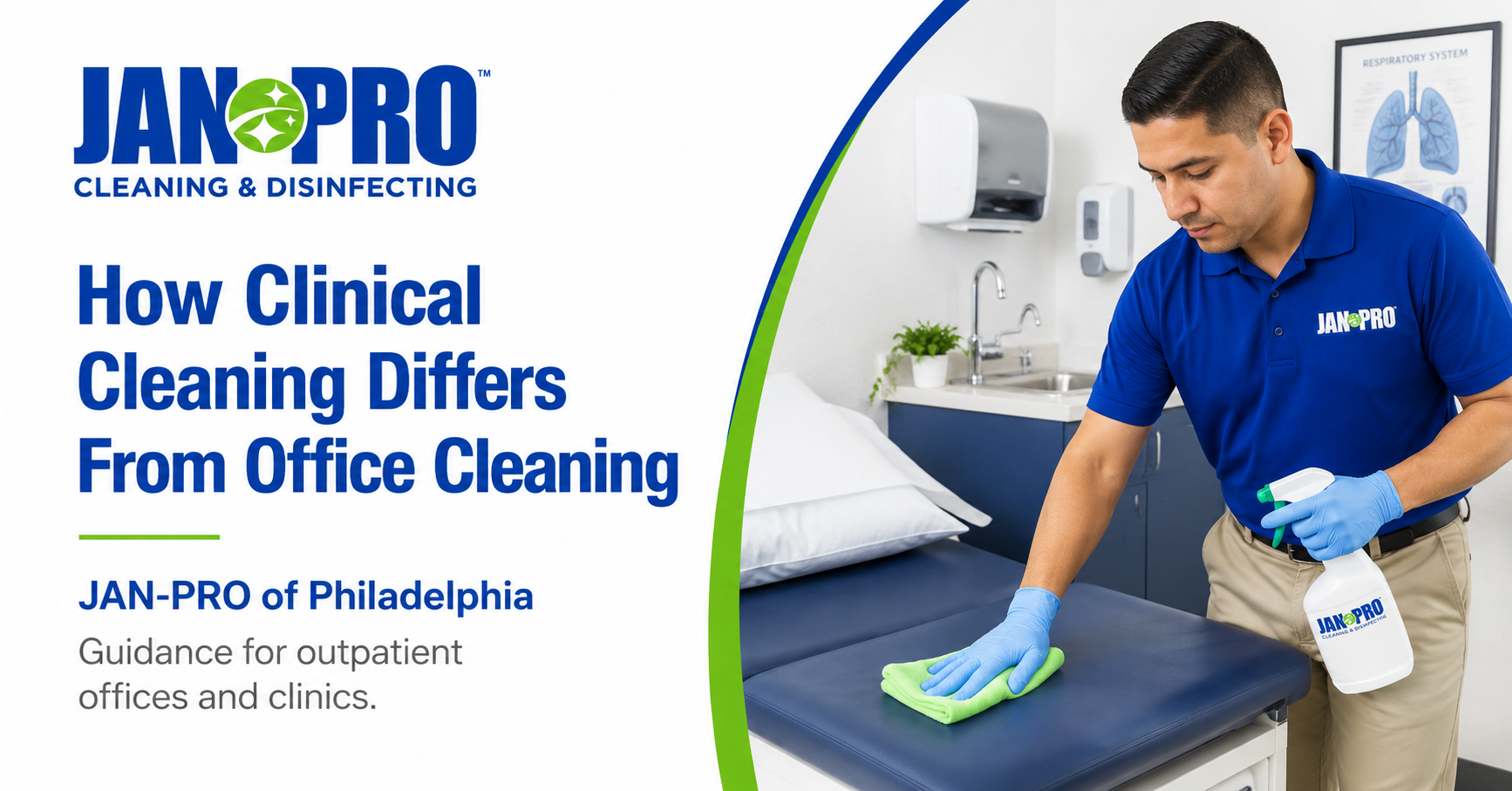
The CDC estimates about 1 in 31 hospital patients has a healthcare-associated infection; the guidance covers surface disinfection in outpatient care.
PHILADELPHIA, PENNSYLVANIA, UNITED STATES, PA, UNITED STATES, July 23, 2026 /EINPresswire.com/ — JAN-PRO Cleaning & Disinfecting in Philadelphia has released guidance on how clinical cleaning differs from general office cleaning. The CDC estimates that on any given day about 1 in 31 hospital patients has at least one healthcare-associated infection, and contaminated environmental surfaces are an established route of transmission. The same pathogens documented in hospital settings — including C. diff, MRSA, and norovirus — are also found in the outpatient offices, clinics, and specialty practices where most patients receive care.
Clinical settings are subject to standards — including CDC environmental cleaning guidance and OSHA’s Bloodborne Pathogens Standard — that general office cleaning scopes do not address. According to the guidance, clinical cleaning differs in method, sequence, and documentation:
Cleaning precedes disinfecting. Disinfectant applied over visible soil does not reach the pathogens beneath it. Surfaces are cleaned first, then disinfected, as two distinct steps.
Hospital-grade disinfectants used at labeled contact times. Every disinfectant lists a dwell time on its label — the number of minutes it must stay wet to kill what it claims to kill. Surfaces wiped dry early have not been fully disinfected.
Color-coded materials to prevent cross-contamination. Color-coded microfiber systems physically separate restroom materials from exam-surface materials, keeping the separation visible.
A documented protocol mapped to standards. Written protocols referencing CDC guidance and OSHA requirements provide the documentation reviewed when a practice is audited.
Training specific to clinical environments. Waiting rooms, exam rooms, and procedure rooms carry different requirements, including how regulated areas are handled.
“A medical office is not just an office, but a lot of them get cleaned like one,” said Chad Janak, President at JAN-PRO Cleaning & Disinfecting in Philadelphia. “The questions a practice manager should ask are simple ones. Do you clean before you disinfect? Can you show me your protocol? If the answers aren’t immediate, that tells you something.”
Philadelphia is one of the country’s major centers of medicine, with a dense network of hospital-affiliated practices, independent clinics, and specialty offices across the city and Montgomery, Delaware, Chester, and Bucks counties — each carrying infection-control responsibility regardless of size. The office provides medical office cleaning in Philadelphia, commercial cleaning in Philadelphia, and medical facility cleaning in Montgomery County. Protocol reviews and facility walkthroughs are available by request at (610) 209-7589.
Andrew Johnson
JAN-PRO Cleaning & Disinfecting in Philadelphia
+1 610-209-7589
email us here
Visit us on social media:
LinkedIn
Instagram
Facebook
Other
Legal Disclaimer:
EIN Presswire provides this news content “as is” without warranty of any kind. We do not accept any responsibility or liability
for the accuracy, content, images, videos, licenses, completeness, legality, or reliability of the information contained in this
article. If you have any complaints or copyright issues related to this article, kindly contact the author above.

Media gallery