88% of the most productive AI users feel burned out (survey by Upwork, 2025). A new dossier shows why that is a design problem, not a resilience problem.
PADERBORN, NRW, GERMANY, June 3, 2026 /EINPresswire.com/ — J. Amelunxen, an independent software architect and AI coach, has published the dossier “The Oversight Tax.” It shows why the most productive AI users are the ones who burn out first, 88 percent of them feel burned out, and why this is not a resilience problem but a design problem. It hits small businesses hardest, the ones who carry the load without the buffer of a large organization.
It is close to midnight. The AI saved time all day, drafted every email, delivered every first version. And the head is still full. That evening, familiar to so many owners and employees of small businesses but rarely named, is what the dossier takes apart.
The contradiction is already daily reality in many small businesses: AI promises relief, yet the workers with the highest productivity gains are the ones who feel burned out most often. The 88 percent figure comes from the Upwork Research Institute, and the same group is twice as likely to consider quitting (vendor survey, self-reported, n=2,500). For Amelunxen this is no accident, and it cannot be trained away.
The term Oversight Tax is familiar from organizational research, where it names the hidden cost of over-control and approval bottlenecks. Amelunxen applies it to AI supervision: the invisible tax that poorly embedded AI levies on the attention of its human supervisor. The constant checking, contextualizing, reworking.
The mechanism behind it is 40 years old. As early as 1983, ergonomist Lisanne Bainbridge showed that automation takes the easy work off the human and leaves precisely the exhausting monitoring that cannot be automated. Later research established that this failure of oversight is structural. It hits laypeople and experts alike, and no amount of training shrinks it. Only a changed system does.
“The right lever is not to try harder or focus better,” said Amelunxen. “If the problem is in the blueprint, you have to design it out, not train it out.”
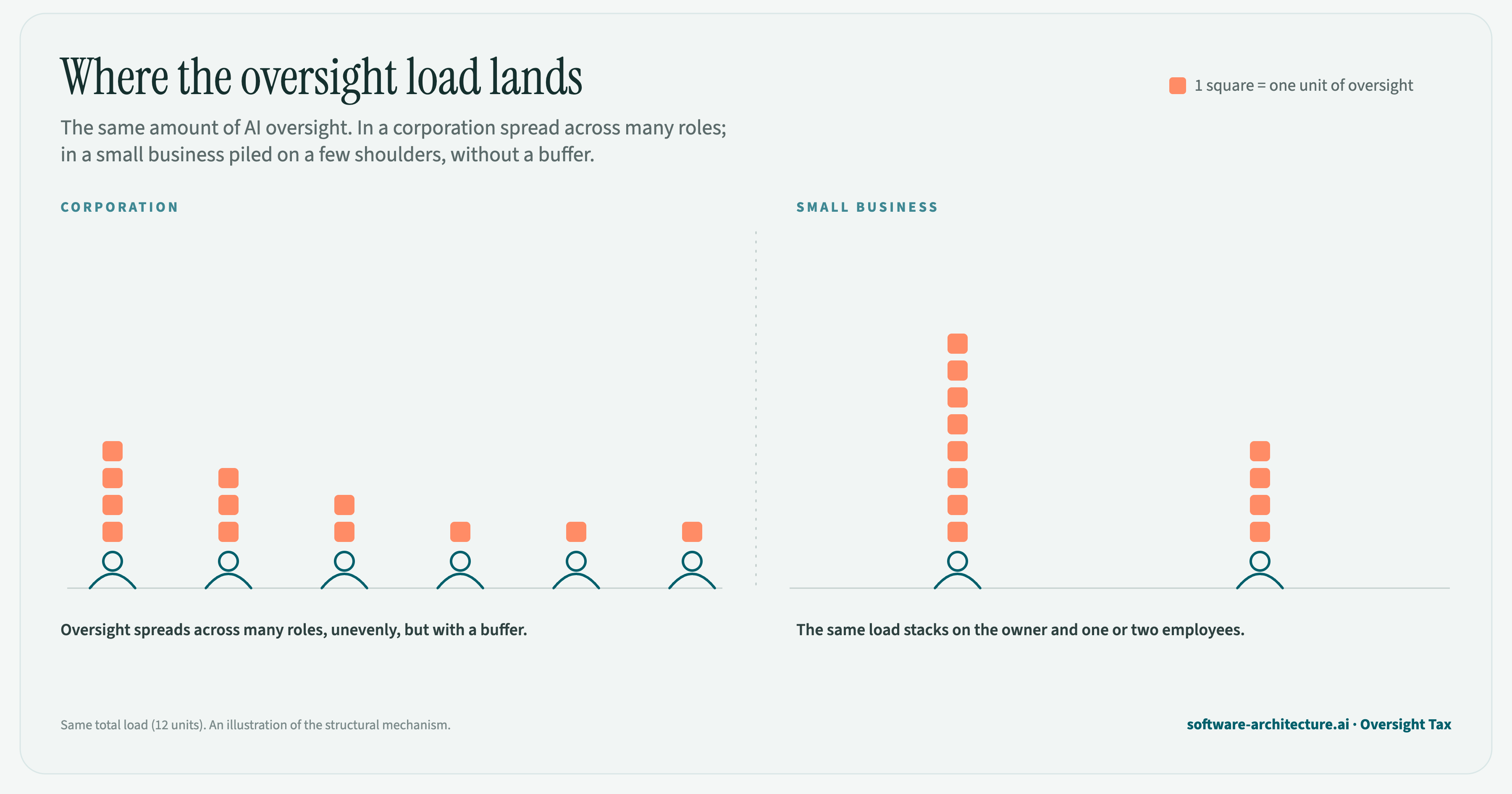
Why does it hit small businesses hardest? For a structural reason. In a large company the oversight is spread across many shoulders. One person curates the tools, another reviews the output, a third carries the liability. In a small business it all falls on a few, and the same people do the actual work on top of it.
“It is close to midnight, and your head is still full, even though the AI saved time all day,” Amelunxen added. “The goal is AI that makes the to-do list in your head shorter, not longer. No one can promise that an AI never gets it wrong. But the load of supervising it can be lowered.”
At one point the dossier exposes a research gap. There are studies on the digital strain on small-business owners, such as the AMAROK observatory in France. And there is research on AI technostress among employees of larger organizations.
What is missing is the intersection: the AI-driven oversight load inside a small business, where a few people carry it without a buffer, owners and team alike, in the German-speaking region.
To close this gap, Amelunxen is preparing an original survey. For the workload it adopts the established techno-overload dimension of the Technostress Creators Scale (Ragu-Nathan & Tarafdar 2008) and adds a new exploratory block on the AI oversight load. Anyone who works in or runs a small business and would like to take part can find the link at https://software-architecture.ai/umfrage/oversight-tax
The full dossier is available at no cost at https://software-architecture.ai/research/oversight-tax
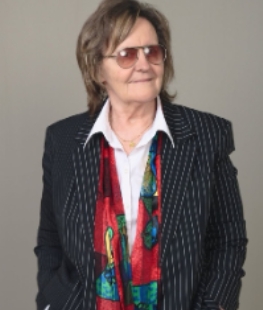
Portrait
J. Amelunxen works as an independent software architect and AI coach with values-led small and mid-sized businesses. The work spans AI architecture, agent design, and the integration of AI agents into existing organizations, focused on the SMB segment, not on enterprise platforms or large-scale consulting mandates.
One central lens in this practice is Habitat Engineering: treating AI not as one more standalone tool dropped into the business, but as an embedded habitat designed to keep the oversight load low from the start. Amelunxen treats AI as a tool that should leave more of the human in the workday, not less. More at software-architecture.ai.
Joerg Amelunxen
Software-Architektur Amelunxen
email us here
Visit us on social media:
Instagram
YouTube
TikTok
Legal Disclaimer:
EIN Presswire provides this news content “as is” without warranty of any kind. We do not accept any responsibility or liability
for the accuracy, content, images, videos, licenses, completeness, legality, or reliability of the information contained in this
article. If you have any complaints or copyright issues related to this article, kindly contact the author above.

Media gallery